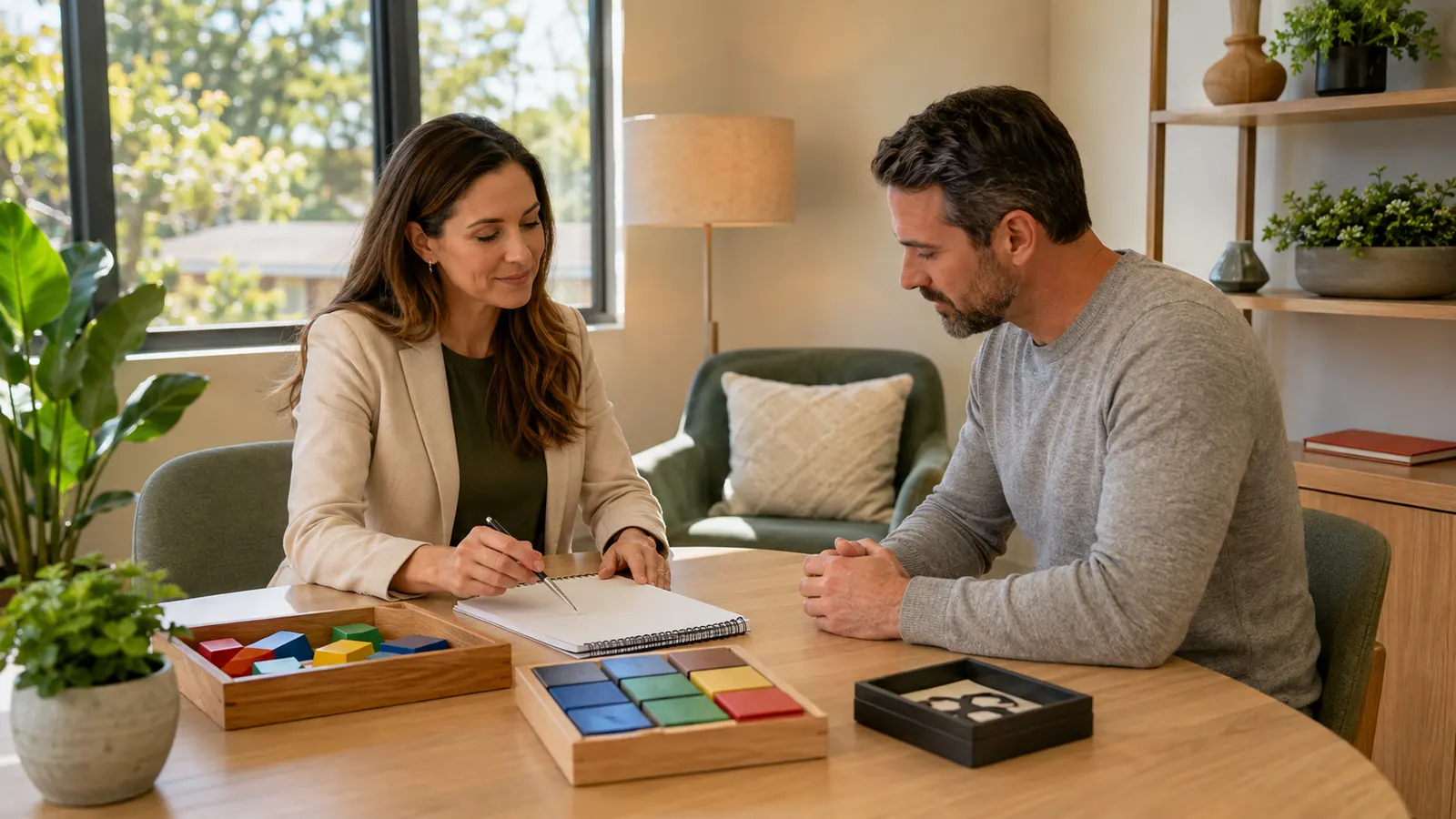
Deciding to pursue psychological testing can bring up plenty of questions. What will you be asked? How long will testing take? Are there right and wrong answers? And perhaps most importantly, what will you actually learn when the evaluation is finished?
Psychological testing is much more comprehensive than completing a questionnaire or taking an online screening test. A professional evaluation brings together information from interviews, standardized assessment tools, relevant history, observations, and other appropriate sources to develop a clearer picture of a person's cognitive, emotional, behavioral, or developmental functioning.
For people researching psychological testing in Orange County, understanding this process beforehand can make an evaluation feel considerably more manageable. Testing is designed to investigate specific questions—not to judge someone's intelligence, personality, parenting, academic ability, or personal worth.
At Shanti Orange County, psychological assessment is available for individuals ages six and older. Depending on the referral question, evaluations may explore concerns involving ADHD, specific learning disorders, executive functioning, Autism Spectrum Disorder, mood, trauma/PTSD, personality, or thought disorders.
If you're considering an evaluation, learning about Shanti OC's psychological testing and evaluation services is a useful starting point for understanding what testing can involve.
What Is Psychological Testing?
Testing Is a Structured Evaluation Process
Psychological testing refers to the use of professionally administered assessment methods to investigate specific questions about psychological or cognitive functioning.
The exact evaluation depends on the reason someone was referred.
A child struggling academically may need an assessment that explores learning and cognitive functioning. An adult experiencing persistent attention and organization difficulties may need a different combination of measures to investigate ADHD and executive functioning.
Someone experiencing complex emotional symptoms may require another assessment approach entirely.
This is why there isn't one universal "psychological test" administered to everyone.
A Test Score Isn't the Entire Evaluation
Standardized assessment scores provide useful information, but they aren't intended to exist in isolation.
A psychologist interprets results alongside other relevant information, which may include clinical interviews, personal history, behavioral observations, questionnaires, educational or medical records when appropriate, and other available data.
Patterns across these sources are often more meaningful than one score by itself.
A comprehensive evaluation therefore asks not only "What was the score?" but also "What does this pattern mean in the context of this individual?"
Why Someone Might Seek Psychological Testing
Persistent Difficulties May Need More Investigation
People pursue psychological evaluation for many different reasons.
Sometimes difficulties are obvious but their cause isn't.
A student might consistently struggle with reading despite significant effort. An adult may experience years of distractibility, disorganization, or difficulty completing tasks but remain uncertain whether ADHD, anxiety, another issue, or several overlapping factors are involved.
Testing can help investigate these questions systematically.
Testing Can Explore Several Areas
Depending on the referral question and individual circumstances, psychological evaluation may investigate areas such as:
- Attention
- Executive functioning
- Learning
- Cognitive abilities
- Memory
- Emotional functioning
- Behavior
- Developmental characteristics
- Personality
- Trauma-related symptoms
Shanti OC specifically provides assessment for concerns including specific learning disorders, ADHD, executive functioning, Autism Spectrum Disorder, mood concerns, trauma/PTSD, personality disorders, and thought disorders.
Not every person needs to be evaluated in every area.
The referral question helps determine which assessments are relevant.
Step 1: Clarifying the Referral Question
Good Testing Starts With the Right Question
Before selecting tests, the psychologist needs to understand what the evaluation is trying to determine.
A referral question might involve:
"Why is my child struggling academically despite receiving extra support?"
"Could attention difficulties be affecting my performance at work?"
"Are these challenges consistent with a learning disorder?"
"Could several different conditions be contributing to these symptoms?"
The clearer the question becomes, the more targeted the evaluation can be.
Similar Symptoms Can Have Different Explanations
Difficulty concentrating is a useful example.
Attention problems can be associated with ADHD, but concentration may also be affected by anxiety, depression, trauma, sleep difficulties, environmental stress, learning problems, and other factors.
That is one reason comprehensive evaluation is valuable.
Rather than starting with a conclusion and trying to prove it, testing can examine relevant possibilities and look at the overall pattern of findings.
Step 2: Completing the Initial Intake
The First Appointment Builds Context
At Shanti OC, psychological testing begins with an intake that generally lasts between one and two hours.
This conversation gives the psychologist an opportunity to understand the reason for the evaluation and gather relevant background information.
Depending on age and referral question, the discussion may cover areas such as:
- Current concerns
- When difficulties began
- Developmental history
- Academic history
- Work functioning
- Medical history
- Previous mental health care
- Family history
- Relationships
- Significant life events
- Previous diagnoses
- Previous testing
- Current strengths and challenges
The information gathered helps shape the remainder of the evaluation.
Be Open About What You're Experiencing
There is little benefit in trying to present the "best" version of yourself during psychological testing.
The evaluator needs accurate information.
If you've struggled with organization since childhood, mention it. If symptoms only appeared recently, that distinction is also important.
Likewise, parents should describe both concerns and strengths rather than trying to predict what information supports a particular diagnosis.
Accurate context supports a more meaningful interpretation.
Step 3: Selecting the Appropriate Psychological Tests
Not Everyone Receives the Same Test Battery
Once the referral question and background have been established, the psychologist determines which assessment tools are appropriate.
The collection of measures used is sometimes referred to as a test battery.
A battery investigating a possible learning disorder will not necessarily look identical to an evaluation focused primarily on ADHD, autism, trauma, or emotional functioning.
The assessment is selected according to the individual rather than forcing every client through the same sequence.
Standardized Tests Allow Meaningful Comparison
Many psychological assessments are standardized.
This means they have established administration and scoring procedures and can provide information about how someone's performance compares with appropriate reference groups.
The interpretation is more nuanced than simply determining whether a score is "good" or "bad."
Psychologists look for patterns across areas of functioning and consider those patterns alongside the person's history, symptoms, and real-world difficulties.
Step 4: Completing the Testing Sessions
Psychological Testing Can Take Several Hours
Comprehensive testing isn't usually completed in ten or twenty minutes.
At Shanti OC, testing typically occurs across two to three appointments, with individual sessions generally lasting approximately two to four hours depending on the tests required and the person being evaluated.
That time allows the psychologist to examine relevant areas in sufficient depth.
Testing may include tasks involving problem-solving, memory, attention, academic skills, questionnaires, or other psychological measures depending on the evaluation.
Different Tasks Can Feel Very Different
Some assessment activities may feel relatively easy.
Others are intentionally designed to become challenging.
That doesn't mean you're failing.
Psychological tests often need to explore both strengths and limitations to understand how a person functions across different levels of difficulty.
The best approach is usually to follow the instructions, make a genuine effort, and ask for clarification if you don't understand what you're being asked to do.
Are There Right and Wrong Answers?
It Depends on the Assessment
Some cognitive or academic tasks have objectively correct responses.
Other measures investigate experiences, symptoms, behaviors, preferences, or emotional functioning and aren't comparable to a school exam.
Trying to determine what answer "looks best" can interfere with the usefulness of the assessment.
Answer as accurately as possible.
You Don't Need to Study
Psychological testing generally isn't something you should prepare for by memorizing answers.
In fact, trying to practice specific assessment items beforehand can reduce the validity or usefulness of some tests.
Instead, focus on practical preparation.
Get appropriate rest, eat normally, bring any requested documentation, take prescribed medications as directed unless your healthcare professional has instructed otherwise, and arrive prepared to put forth a reasonable effort.
Step 5: Looking at More Than Test Performance
Context Helps Explain the Numbers
A test result doesn't automatically explain why someone functions a certain way in everyday life.
Suppose an individual performs well on a structured attention task but reports major difficulties organizing complex projects at work.
That difference deserves interpretation.
Likewise, someone may demonstrate strong reasoning abilities while experiencing a specific weakness in another area that significantly affects academic performance.
The psychologist's role is to interpret these relationships rather than merely produce a table of scores.
Records May Add Important Information
When relevant and available, previous records may provide useful context.
These might include previous evaluations, academic records, treatment history, or other appropriate documentation.
For younger clients, information from parents, caregivers, teachers, or other relevant people may sometimes contribute to understanding functioning across environments.
The psychologist determines which sources are appropriate for the specific evaluation.
Step 6: Understanding Strengths as Well as Difficulties
Psychological Testing Isn't Only About Finding Problems
One of the most useful aspects of comprehensive assessment is identifying areas of relative strength.
Someone may have difficulty with one type of learning while demonstrating strong abilities elsewhere.
Another person may struggle with executive functioning but possess significant reasoning, verbal, creative, or problem-solving strengths.
Recognizing these patterns can influence recommendations.
Instead of only asking, "What is wrong?" testing can help answer, "How does this person learn, process information, and function most effectively?"
Strengths Can Inform Practical Strategies
Recommendations become more useful when they work with the individual's strengths.
For example, a person who struggles with one method of processing information may benefit from strategies that rely more heavily on stronger areas.
This is one reason individualized assessment can provide more value than generic advice.
The objective is not merely categorization.
It is understanding.
Step 7: Scoring and Interpreting the Results
The Work Continues After You Leave
When the testing appointment ends, the evaluation isn't finished.
The psychologist must score relevant measures, review information, compare findings across assessments, interpret patterns, and integrate those findings with the clinical history and referral question.
This process requires professional judgment.
One elevated questionnaire score or weak test result isn't necessarily enough to support a conclusion by itself.
Diagnosis May Be One Outcome, but Not the Only Outcome
Some evaluations result in a formal diagnosis.
Others may clarify that the available findings don't support the diagnosis initially suspected.
Testing may also identify strengths, functional challenges, areas requiring additional evaluation, or practical recommendations even when no new diagnosis is made.
A useful assessment should improve understanding regardless of whether a particular label is ultimately assigned.
Step 8: Receiving Your Psychological Testing Results
Expect a Feedback Session
At Shanti OC, a review appointment generally takes place approximately two to three weeks after testing.
During this session, findings can be explained in understandable terms.
You should have an opportunity to discuss:
- Important findings
- Areas of strength
- Areas of difficulty
- Relevant diagnoses, when applicable
- How the findings relate to everyday functioning
- Recommendations
- Appropriate referrals
- Questions about the results
This appointment can be just as important as the testing itself.
Ask Questions Until the Findings Make Sense
Psychological reports can contain unfamiliar terminology.
Don't hesitate to ask what something means.
Useful questions include:
"What does this finding mean in everyday life?"
"Which results are most important?"
"What should we prioritize next?"
"What support might help?"
"Is additional evaluation recommended?"
The objective isn't simply to hand you scores. It is to help you understand what the findings mean and what you can do with that information.
Step 9: Receiving the Written Report
The Report Brings the Evaluation Together
Shanti OC provides a detailed written report as part of its psychological evaluation process.
The document brings together the relevant findings, conclusions, and recommendations from the assessment.
Depending on the evaluation, it may include discussion of the referral question, background information, tests administered, behavioral observations, results, interpretation, diagnoses when appropriate, and recommendations.
Keep the report somewhere secure.
It may become useful when coordinating future care or services.
Recommendations Are Often the Most Actionable Part
A diagnosis can provide clarity, but the practical recommendations help translate that understanding into action.
Depending on the findings, recommendations could involve:
- Mental health treatment
- Academic support
- Skill-building strategies
- Behavioral interventions
- Organizational strategies
- Additional medical or specialist evaluation
- Other appropriate resources
The recommendations should reflect the individual's actual assessment results rather than generic advice.
Psychological Testing for Children and Adolescents
Testing Can Clarify Academic and Developmental Concerns
Children don't always have the vocabulary to explain why school feels unusually difficult.
A child might appear inattentive when they are struggling to understand the material. Another might perform well academically while using enormous effort to compensate for an underlying difficulty.
Testing can help investigate these patterns.
It can also provide parents with a more organized understanding of strengths and challenges.
The Goal Isn't to Put a Label on a Child
Parents sometimes worry that psychological testing will permanently define their child.
A thoughtful evaluation should do the opposite.
It should provide greater clarity about how the child functions and what types of support may be useful.
When a diagnosis is appropriate, it is one part of understanding the child—not their identity.
Psychological Testing for Adults
Adults Can Seek Evaluation Too
Not every psychological or learning concern is recognized during childhood.
Some adults develop coping strategies that allow them to function for years before increasing academic, occupational, parenting, or organizational demands expose persistent difficulties.
Others begin reconsidering longstanding experiences after a family member receives a diagnosis.
Psychological testing can provide an opportunity to investigate those concerns systematically.
Testing Can Help Explain Longstanding Patterns
An adult may have spent years believing they were simply disorganized, bad at studying, unusually forgetful, or incapable of managing certain tasks.
An evaluation may provide a more nuanced understanding.
Even when testing doesn't result in the diagnosis the person expected, identifying patterns of strengths and challenges can still help guide strategies and future support.
How to Prepare for Psychological Testing in Orange County
Gather Relevant Information Beforehand
Preparation doesn't mean studying for the tests.
Instead, organize information that could help the psychologist understand your history.
Depending on your circumstances, useful materials may include:
- Previous psychological evaluations
- Relevant educational records
- Medication information
- Treatment history
- Questions you want answered
- Notes about symptoms or difficulties
- Other records specifically requested by the evaluator
Ask the provider beforehand what they would like you to bring.
Prepare for a Longer Appointment
Because comprehensive assessment can take several hours, plan accordingly.
Avoid scheduling important commitments immediately afterward when possible.
Follow instructions regarding food, breaks, medications, glasses, hearing aids, or other practical considerations provided by the evaluator.
For people new to Shanti OC, reviewing what to expect during a first visit can also make the initial process easier to navigate.
What Happens After Psychological Testing?
Results Should Lead to a Practical Next Step
Testing shouldn't end with, "Here are your scores."
The findings should help inform what happens next.
That could involve therapy, educational support, behavioral strategies, workplace or academic discussions where applicable, another healthcare referral, or simply a better understanding of how to approach particular challenges.
The next step depends entirely on what the evaluation identifies.
Testing and Counseling Serve Different Purposes
Psychological assessment helps answer diagnostic and functional questions.
Counseling focuses more directly on therapeutic support, coping, behavioral or emotional concerns, relationships, and other mental health needs.
Sometimes an assessment leads to a recommendation for therapy.
Shanti OC also provides mental health counseling in Orange County for individuals seeking ongoing therapeutic support.
Choosing Psychological Testing in Orange County
Look for a Comprehensive Evaluation Process
When considering a provider, ask what the evaluation includes.
Useful questions might include:
- Who performs the testing?
- What happens during intake?
- How are tests selected?
- How many appointments should I expect?
- Is a feedback session included?
- Will I receive a written report?
- How are recommendations developed?
- What happens if another referral is needed?
The answers can help you understand whether the service is designed to provide a comprehensive evaluation rather than only a screening.
Find a Setting Where You Can Ask Questions
Psychological testing can involve personal information and unfamiliar terminology.
You should feel comfortable asking questions throughout the process.
Shanti Orange County approaches psychological assessment as part of its broader commitment to accessible and affirming mental health care, with evaluations available for individuals ages six and older.
For people seeking psychological testing in Orange County, the objective should be more than obtaining a test score. A strong evaluation should provide useful insight into how someone thinks, learns, feels, behaves, and functions—and turn those findings into practical recommendations.